MES vs ERP for Manufacturers: Shop Floor Roles and the Production OS

MES executes production in real time. ERP plans and records the business around it. MES tells you whether a machine ran the right recipe at 2:14 p.m.; ERP tells finance what that batch cost and whether you can promise the next order. That's the textbook answer, and it's correct.
Here's what the textbook leaves out: neither system understands your machines. MES records what happened. ERP records what was planned. The gap between the two — why the plan didn't survive the morning, which press is three days from failing, where the hidden capacity sits — is closed every single day by your most expensive people, by hand, usually in Excel. "MES vs ERP" is the question the software market taught you to ask. The question that actually moves your output is: who does the understanding?
TL;DR:
- MES = real-time execution at machine and unit level (ISA-95 Level 3). ERP = planning, inventory, and finance at batch and SKU level (Level 4). Most manufacturers beyond simple, low-mix production genuinely need both. Nobody serious disputes this.
- What ISA-95 doesn't have a level for: the reconciliation between plan and reality. Today that layer is your planners — human middleware between two systems that don't understand machines.
- Integration moves data between MES and ERP. It does not move understanding. After a textbook integration, a press three days from failure is still scheduled like a healthy one.
- A production operating system is the layer built for exactly that gap: it reads what MES, ERP, SCADA, and your historians already record, learns how each machine actually behaves, and turns that into scheduling and maintenance decisions — with your sign-off.
- You don't have to replace anything to find out if this is real. Your database already contains the answer. Read it first.
Table of Contents
- What Is an MES?
- What Is an ERP?
- What Are the Key Differences Between MES and ERP?
- How the Market Answers "MES vs ERP" — and Where That Breaks
- How Do MES and ERP Integrate?
- Do You Need ERP, MES, or Both?
- Where a Production Operating System Fits
- Author Perspective: Get the Sequence Right Before You Integrate Anything
- See What Your Historical Data Already Shows You
- Sources
- FAQ
What Is an MES?
A manufacturing execution system (MES) is the software layer that watches, records, and directs what happens on the shop floor as it happens. Supervisors release work orders to a line with it. Operators pull digital work instructions instead of paper travelers. Quality teams enforce holds automatically when a reading falls out of spec.
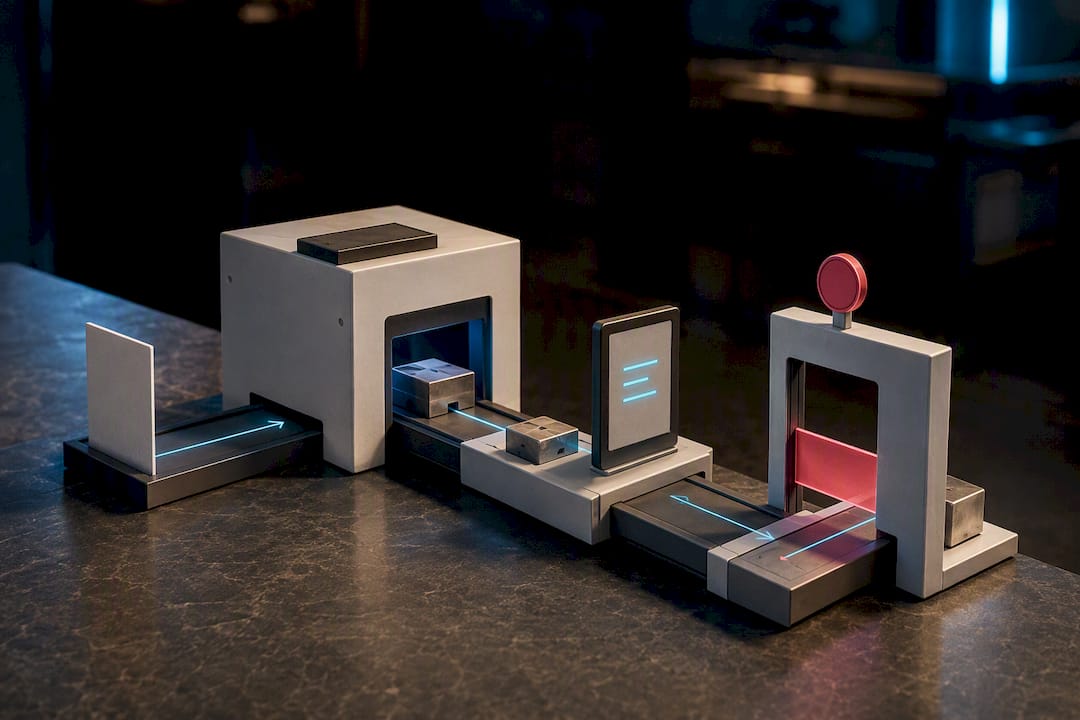
MES connects straight into the equipment generating the data. It talks to PLCs and SCADA systems, pulls machine states, and logs events down to a single unit passing a single station at a specific timestamp. That granularity makes MES the system of record for things ERP was never built to track.
Core MES functions:
- Real-time OEE tracking (availability, performance, quality) tied to individual machines and shifts.
- Digital work instructions that update when a routing or specification changes.
- Genealogy and batch traceability, down to the raw material lot inside a specific finished unit.
- Automated quality holds and electronic batch records for regulated production.
- Direct machine and PLC connectivity for status, cycle time, and fault data.
One honest caveat the brochures skip: MES records machine behavior. It does not learn it. An MES will faithfully log the same chronic quirk on the same press every day for six years — and never once tell you it's a quirk, not a fault.
What Is an ERP?
An enterprise resource planning (ERP) system is the system of record for the business itself: what you sold, what you owe, what you hold in inventory, and what you plan to produce over the coming weeks or months. Finance closes the books in it. Procurement issues purchase orders from it. Planners run MRP in it.
ERP operates on a longer clock and a coarser resolution than MES. It thinks in SKUs, batches, and shifts — not machine cycles.
Core ERP modules relevant to manufacturing:
- MRP and production scheduling at order or batch level.
- Inventory and warehouse management tied to financial valuation.
- Procurement and supplier management.
- Finance and cost accounting, including standard costing and variance analysis.
- Master data for items, bills of materials, and customers.
And one honest caveat here too: ERP plans against the data sheet. Its scheduling module assumes every machine delivers nominal cycle times, every day, forever. In one real plant we read, the best machine ran at 70% real efficiency and the worst at 11% — and the ERP plan treated them as identical. A plan built on catalog numbers is fiction with a Gantt chart.
What Are the Key Differences Between MES and ERP?
The clean separation is time horizon. ERP works in hours to months: planning production, forecasting demand, closing financial periods. MES works in seconds to hours: executing the order ERP released and confirming it happened correctly.
Data granularity follows the same split: MES logs at machine, operator, unit, and timestamp level; ERP aggregates at SKU, batch, or shift level, typically in batch updates rather than continuously.
Worth knowing: the ISA-95 standard formalizes this boundary as Level 3 (MES) versus Level 4 (ERP) — which is why serious manufacturers end up running both rather than choosing one.
The two systems answer different questions:
- MES answers: "Is production happening correctly, right now, on this line?"
- ERP answers: "What should we plan, order, build, and record for the business?"
But notice the question neither answers: "Given how my machines are actually behaving today, what should the plan become?" ISA-95 has a level for execution and a level for planning. It has no level for understanding. In most plants, that level exists anyway — it's called the morning meeting, and it's staffed by planners re-typing reality into the ERP by hand.
Your planners are the middleware. That's the bug.
How the Market Answers "MES vs ERP" — and Where That Breaks
"Integrate MES and ERP and you're done." Integration moves confirmations up and orders down. It does not move understanding in either direction. After a textbook ISA-95 integration, the scheduler still can't see that a press is drifting toward failure, and the MES still doesn't know which delivery that press is about to endanger. Integration moves data. It doesn't move understanding.
"Our ERP production module is enough." ERP shop-floor modules stop at work-order management and manual confirmations. No machine-level connectivity, no real OEE, no automated quality enforcement — and capacity figures configured once at go-live that drift from reality forever after. Configured capacity is an opinion. Measured capacity is a fact.
"Just add an analytics dashboard on top." A dashboard is a third screen for your planners to reconcile against the other two. If the insight doesn't change the production plan by itself, the coordination work never left their desk. Insight that ends in a dashboard is your own work, outsourced back to you.
How Do MES and ERP Integrate?
Where integration is genuinely needed, do it properly. It follows the ISA-95 model almost universally: production orders, BOMs, and priorities flow down from ERP (Level 4) into MES (Level 3); confirmed actuals — quantities, scrap, downtime, quality results — flow back up for reconciliation.
In practice:
- Standard data mappings. ISA-95 Part 5 and the B2MML schema give integration projects a repeatable structure for translating ERP work orders into MES execution records.
- Middleware and API-first connectors. Most plants route data through a middleware layer that absorbs schema changes on either side without breaking the chain.
- Scheduled and event-driven sync. Order releases can sync on a schedule; quality holds and downtime events need to push in real time.
Pro Tip: Align item masters, routings, and units of measure between ERP and MES before you connect anything. Mismatched master data is the most common cause of "phantom" discrepancies — and far cheaper to fix before go-live than after.
Do You Need ERP, MES, or Both?
Honest answer, no agenda: start with ERP alone if you run a single site with simple, low-mix production and manual process controls genuinely suffice. Add MES quickly if you're regulated (electronic batch records, genealogy), need OEE from machine data instead of hand-logged shift reports, or need quality holds to trigger at the machine. Run both, integrated, once complexity outgrows manual reconciliation. Manufacturers that target a specific floor-level problem with MES often see payback within 12 to 18 months.
We build neither an MES nor an ERP, so we have no horse in that race. What we will tell you — because we read plant databases for a living — is what both systems will still be missing the day after go-live: a model of how your machines actually behave. That data already exists. In one rubber-molding plant in northern Italy it had been sitting in the historian for six years — six million readings across 42 machines — and nobody had read it. Not even the software they were paying to do exactly that.
Where a Production Operating System Fits
This is the layer a production operating system is built for — not a third system of record competing with MES and ERP, but the intelligence between them:
- It reads what you already run. PLC, SCADA, MES, ERP, WMS, CMMS, quality, and shift data over read-only data contracts — SQL historians in any dialect, OPC-UA straight from controls. Onboarding is a mapping, not a project. No new sensors to start.
- It learns each machine's signature. Per machine, per recipe, per season — from your own history. In that same plant: 141 machine × recipe signatures, including a factory defect found between two twin presses. Same brand, same model, different DNA. For generic software that defect is a daily alarm; for a learned signature it's just who that machine is.
- It plans on effective capacity. Observed pieces/hour × availability × health — never the data sheet. An at-risk machine carries less load before it fails, and the schedule rebuilds in minutes when reality moves, not at tomorrow's meeting.
- Autonomy is earned, not switched on. First a shadow plan that touches nothing and measures the gap in hours. Then proposals you ratify, with rejections remembered. Then signed guardrails — daily budgets, never critical orders, revocable in one click. Every number carries its source; when the system doesn't know, the screen says "not measured."
- ERP stays the register — if you want. Ratified decisions flow back through a governed, signed write-back channel, and the read path verifies every move actually landed. Your MES and ERP keep their jobs. The reconciliation stops being a human's job.
Three questions for any vendor claiming this layer — ours included:
- What do you know about my plant before anyone configures anything?
- What does your screen show when you don't know?
- What changed in my schedule last week because of your prediction?
If the answers need a slide deck, you already have your answer. We built the product to survive its own questionnaire.
Author Perspective: Get the Sequence Right Before You Integrate Anything
The biggest mistake I see isn't picking the wrong system — it's integrating messy data, then hiring people to reconcile what the integration still can't. Clean your master data. Pilot on one line. And before you sign the next integration project, ask what six years of your own historian would say — because in every plant we've read, it said something nobody in the room knew. The 98 open questions we started with in one plant? The models closed 91 of them from the data alone. Seven survived for the site visit.
See What Your Historical Data Already Shows You
Most plants don't need another dashboard bolted onto MES and ERP. They need one place where the data those systems already collect becomes decisions someone can sign off on.
Here's the dare: send us the raw data your machines already produce. Atherya's Plant Profile assessment reads it and gives you back your plant's story — the real bottleneck, the hidden capacity, the machine with a quirk nobody ever catalogued. In that rubber-molding plant, the presses turned out to run 60.8% of available hours: every hour they lost, the whole plant lost. Real efficiency was 47%, not the number in the monthly report. If nothing in your story surprises you, you've lost thirty minutes. That's the entire risk.
Sources
This article draws on ISA-95 boundary definitions, TechTarget's MES vs ERP comparison, IBM's MES overview, and 3DS/DELMIA's integration guidance. Plant figures (6 years of data, 6M readings, 42 machines, 141 signatures, 60.8%, 47%, 98→7 questions) come from a real onboarding at a rubber-molding plant in northern Italy; scenario figures are always declared as scenarios, never as measurements.
- Cost-effective solutions integrate MES with ERP systems in manufacturing | 3DS/DELMIA
- MES vs. ERP: What's the Difference, and Which One Do You Need? | ReLIAMag
FAQ
Is SCADA a MES System?
No. SCADA collects and displays real-time data from sensors and PLCs, but it doesn't manage work orders, work instructions, or quality holds the way MES does. Many MES platforms sit on top of SCADA. And note: SCADA data is also one of the richest inputs for machine-behavior learning — most plants already have years of it, unread.
What Are the Four Types of ERP?
Generalist/tier-one platforms, industry-specific ERP, small-business ERP with simplified modules, and cloud-native subscription ERP. The right category depends more on company size and complexity than on feature lists. None of the four learns machine behavior — that's not a criticism, it's just not their job.
Is MES Like SAP?
SAP is primarily an ERP platform, though it offers manufacturing execution modules in its suite. A dedicated MES provides deeper machine-level connectivity, real-time OEE, and automated quality enforcement than SAP's built-in production functionality delivers on its own.
Does SAP Have an MES Module?
Yes, but its execution modules generally rely more on manual confirmations than the direct PLC/SCADA integration dedicated MES platforms provide. Regulated or high-complexity manufacturers often deploy standalone MES alongside SAP. Either way, the plan-vs-reality reconciliation between them remains a human job — unless a layer above them owns it.
How Does a Production Operating System Like Atherya Fit Into a MES vs ERP Setup?
Atherya doesn't replace MES or ERP — it reads across both, plus SCADA, PLC, WMS, and CMMS, and builds one learned model of how the plant actually behaves. It coexists first, read-only; proves value on your own data; and writes back to SAP or your ERP only through a signed, governed channel for decisions you ratified. Every number carries its source, so operations and finance finally argue about the same reality.
Recommended
WHERE ATHERYA STANDS ON THIS
The problem on a shop floor is almost never a missing system. It is missing context.
Every plant we walk into already owns more data than it uses: years of machine history, orders, shifts, work orders, maintenance notes. What is missing is not another tool on top of the stack — it is a system that knows this plant. Which machine has run slightly hot since the day it was installed. Which deviation is normal on the night shift. Which alarm the team stopped reading two years ago, and why they were right to stop.
That is the difference between a model that scores signals and a system that has an operational memory. A generic threshold produces a false alarm every day on a machine born with a factory defect. Atherya learns each machine's own normal band first, so only movement beyond its band becomes an alert. Silence is a feature: the alarms that survive are the ones worth waking someone up for.
And an alert that stops at "anomaly detected" moves nothing. Atherya reasons on top of its memory: when this already happened, how similar it was, how it evolved, which action worked, which failure mode the FMEA connects it to. Then it does the part most tools leave to a spreadsheet — it proposes the maintenance window against real orders and real shifts, and replans when something changes. Nothing is ever applied on its own: every action waits for a person to sign it off, and every step leaves a signed, auditable trail.
That is the whole bet. Not one more dashboard to reconcile, not autonomy sold as a switch, but one brain that reads the data you already have — OPC-UA, SQL, MES, ERP, WMS, CMMS — before a single new sensor is installed, explains itself in the open, and gives the decision back to the people who run the plant.
What makes Atherya different
Most predictive maintenance tools score signals. Atherya builds an operational memory of the plant first, then reasons on top of it — with the evidence in plain sight and the decision left to a person.
Operational memory
Every event, anomaly, intervention and shift becomes shared memory. What was a log yesterday is experience tomorrow, and the model reads new signals against it.
Déjà Vu: it has seen this before
Not just "anomaly detected", but when it already happened, how similar it was, how it evolved and which action worked. The senior maintainer's memory, available to everyone.
Context that kills false alarms
Machine defects, weak points, how the crew actually works and the environment around the line. A deviation that is normal for that machine, that shift or that season stays quiet.
Living FMEA
FMEA, manuals and procedures become an active part of the reasoning: causes, effects, sensors and suggested actions are connected, instead of sitting in a document nobody opens.
Explainable, not magic
Every alert arrives with the signals involved, the comparable history, the failure mode and a confidence level. Data, interpretation and decision stay separate and verifiable.
It acts, with your sign-off
Atherya does not stop at the warning: it proposes the maintenance window against real orders and shifts, and replans when something changes. Nothing is applied until a person approves it.
On the data you already have
It works on PLC, SCADA, MES, ERP, maintenance records and feedback as they are — fragmented and legacy included. Sensors are added only where no existing signal carries the degradation.
One brain, not a maintenance silo
Maintenance, production and planning read the same operational state, so a predicted failure immediately becomes a scheduling question instead of a separate dashboard.